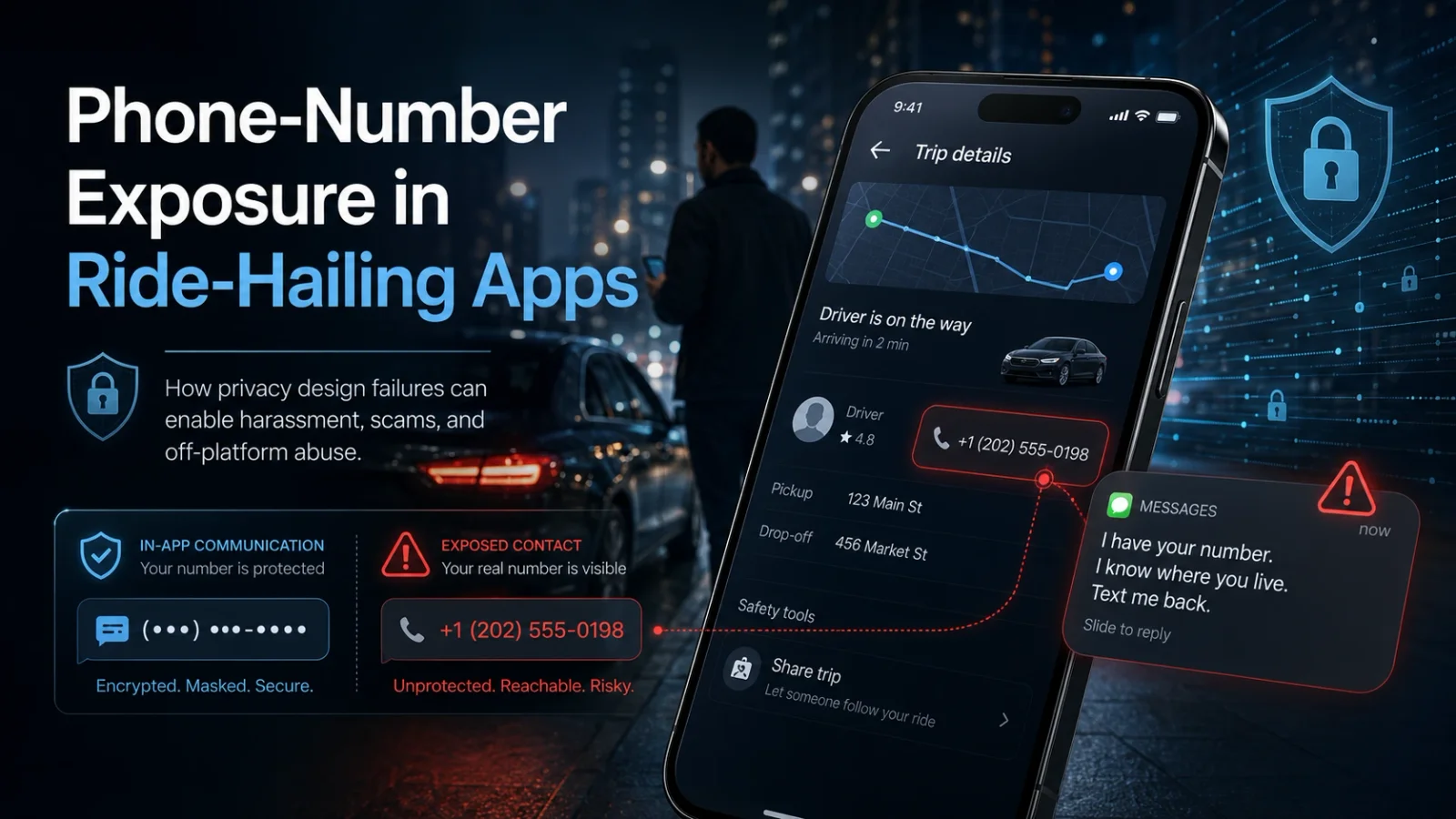
The most serious privacy and cybersecurity concern with Maxim is not necessarily a conventional software breach. The more immediate issue is the way real user phone numbers may be exposed through ordinary platform workflows.
When a ride-hailing or delivery platform exposes a passenger’s real phone number to a driver, courier, carrier, or order participant, it creates a direct off-platform communication channel. That means a user can potentially receive stalking messages, threatening texts, harassment, scam attempts, or retaliation directly to their personal phone number, outside the app’s moderation, blocking, reporting, translation, or safety controls.
This is a serious safety issue because a phone number is rarely exposed in isolation. In a ride or delivery context, it may be connected with pickup location, destination, delivery address, order details, timing, complaints, feedback, and user identity. Once that information leaves the controlled app environment, the platform’s ability to protect the user is significantly reduced.
This article examines Maxim’s publicly visible privacy and security posture, focusing on phone-number exposure, telephony flows, driver and passenger app surfaces, data collection, likely abuse scenarios, regulatory concerns, and practical remediation steps. The findings are framed as a legal, evidence-based risk assessment rather than an allegation of confirmed infrastructure compromise.
Countries Where Maxim Operates or Has Publicly Represented Availability
Maxim’s public materials do not appear to present one perfectly consistent country count. Different official or semi-official sources have referenced different totals, including 19, 21, 22, or more country pages. The safest wording is therefore that Maxim has publicly represented availability, operations, or country-specific service pages across the following markets:
Region Countries: Americas, Argentina, Brazil, Colombia, Dominican Republic, Peru, Asia-Pacific, Bangladesh, Cambodia, Indonesia, Kazakhstan, Kyrgyzstan, Laos, Malaysia, Myanmar, Philippines, Thailand, Uzbekistan, Vanuatu, Vietnam, Africa, South Africa, Tanzania, Eurasia / CIS, Azerbaijan, Russia, Tajikistan
Combined country list: Argentina, Azerbaijan, Bangladesh, Brazil, Cambodia, Colombia, Dominican Republic, Indonesia, Kazakhstan, Kyrgyzstan, Laos, Malaysia, Myanmar, Peru, Philippines, Russia, South Africa, Tajikistan, Tanzania, Thailand, Uzbekistan, Vanuatu, and Vietnam.
Because public country lists vary across Maxim’s own web properties, app-store pages, legal pages, and regional service pages, this list should be treated as a self-disclosed operating or availability footprint, not as a definitive statement of regulatory authorization in every jurisdiction.
The Core Issue: Real Phone Numbers Exposed to Drivers
A modern ride-hailing or delivery app should not normally need to reveal a passenger’s permanent personal phone number to a driver. The safer model is temporary, app-controlled communication: masked numbers, in-app chat, expiring call tokens, or relay-based calling that prevents either party from seeing the other’s real number.
When the real number is exposed, the risk changes. The platform is no longer simply managing a trip. It has created a permanent connection between two people who may never need to interact again.
That can result in:
Direct threatening SMS messages.
Harassing phone calls after a ride.
Retaliation after negative feedback.
Off-platform payment scams.
Stalking using trip or delivery context.
Contact through WhatsApp, Telegram, Viber, Facebook, or other services.
Continued harassment even after a driver is blocked or reported.
Identification of a complainant after a dispute.
This is not just a privacy inconvenience. It is a personal-safety issue.
Why Phone-Number Exposure Is High Risk
A phone number is a persistent identifier. Unlike an in-app chat session, it does not automatically expire when the ride ends. It can be saved, copied, searched, reused, sold, or shared.
In a transport or delivery environment, that number may be connected to highly sensitive context:
Data Point Why It Matters Phone number Allows direct off-platform contact.
Pickup location May reveal home, workplace, hotel, school, or routine.
Drop-off location May reveal destination, habits, relationships, or private activity.
Delivery address May expose the user or a third-party recipient.
Order notes May contain gate codes, names, instructions, or contact details.
Complaint history May identify the person who reported misconduct.
Trip timing May reveal daily patterns or vulnerable moments.
Payment context May support scams or social engineering.
The danger is the combination. A phone number by itself is sensitive. A phone number combined with movement history, order details, complaint context, and location information is far more sensitive.
How Exposure Can Happen
Phone-number exposure can occur through several ordinary platform mechanisms. These do not necessarily require hacking or unauthorized access.
1. Order Details
Delivery and ride-hailing apps often include free-text fields for instructions. Users may enter phone numbers, building details, landmarks, or recipient information. If those details are visible to too many parties, the phone number can leak through the normal order screen.
2. Accepted Order Screens
Some platforms reveal more information to the driver once an order is accepted. While drivers need enough information to complete the job, they do not necessarily need the passenger’s permanent phone number.
3. Complaint and Dispute Workflows
If a user files a complaint and the platform shares the complainant’s phone number or identifying information with the driver or carrier, the complaint process itself can become a retaliation risk.
4. SMS, Voice, and Call Fallbacks
Platforms that rely on SMS, phone calls, voice messages, or telephony relays need strict masking. If masking is incomplete, numbers may appear in call logs, notification history, support records, driver dashboards, or backend logs.
5. Support Dashboards
Customer support systems often centralize user profiles, trip data, phone numbers, messages, and complaints. Weak role-based access control can expose sensitive data to staff, contractors, or regional operators who do not need full access.
6. Driver App Logs and Device History
If communication falls back to native dialing or standard SMS, the phone number may remain in the driver’s device history even after the trip is complete.
Platform Attack Surface
Maxim appears to operate across passenger apps, driver apps, web portals, regional subdomains, support workflows, telephony systems, payment systems, and country-specific legal entities. This creates a broad operational attack surface.
The key risk areas include:
Component Risk Passenger app Handles identity, phone number, location, trip history, and payment context.
Driver app Handles job assignment, passenger interaction, route data, earnings, and driver telemetry.
Web portals May expose login, order, profile, or regional service flows.
Telephony systems Manage SMS, calls, OTPs, voice messages, and possible call recording support systems
Contain complaints, user profiles, trip records, and contact details.
Regional infrastructure May create inconsistent security controls between countries.
Legal and data-sharing workflows May determine when user data is shared with drivers, carriers, affiliates, or third parties.
A large platform does not need one catastrophic breach to create user harm. In many cases, the risk comes from overexposed data inside legitimate workflows.
Possible Exploitation and Abuse Scenarios
The following scenarios are presented as possible risk models, not as claims of confirmed exploitation in every market.
Scenario 1: Driver Harassment After a Ride
A driver receives the passenger’s real phone number during or after the ride. After a cancellation, complaint, poor rating, or payment dispute, the driver sends threatening or abusive messages directly to the passenger’s phone.
Risk level: High
Reason: The communication happens outside the app, making it harder to moderate, block, or detect.
Scenario 2: Retaliation After Negative Feedback
If the driver can identify who left a complaint or negative review, they may retaliate through calls, SMS, or messaging apps.
Risk level: High
Reason: Complaint systems must protect users from being identified by the person they are reporting.
Scenario 3: Delivery Scam Using Order Details
A scammer or rogue participant sees delivery information, recipient details, phone number, item description, or payment amount. They contact the recipient pretending to be the courier and request extra payment, advance settlement, or verification codes.
Risk level: High
Reason: Delivery metadata makes scams more convincing.
Scenario 4: Stalking Through Location and Contact Data
A phone number connected to pickup and drop-off points can reveal where a user lives, works, studies, or regularly travels.
Risk level: High
Reason: Ride-hailing data is movement data, and movement data is highly sensitive.
Scenario 5: Support or Insider Misuse
A person with dashboard access searches for a user, views contact details, trip history, complaints, or addresses, and uses that information improperly.
Risk level: Medium to high
Reason: Insider access is one of the most common privacy risks in large operational platforms.
Scenario 6: Excessive Driver Telemetry
Driver apps may collect detailed operational and device data. While some telemetry is needed for dispatch and fraud prevention, overly broad collection can create privacy and proportionality concerns.
Risk level: Medium to high
Reason: Driver-side surveillance can become intrusive if not minimized and clearly justified.
Scenario 7: Telephony Metadata Exposure
SMS, OTP, call, and voice-message systems generate logs. If those logs contain raw phone numbers or are retained too long, they become another sensitive data store.
Risk level: Medium
Reason: Telephony metadata can reveal identity, timing, and interaction patterns.
Risk Matrix
Risk Area Severity Confidence Notes Real phone-number exposure
High Public materials support this as a genuine privacy concern.
Off-platform harassment High Medium
Highly plausible where raw numbers are visible.
Complaint de-anonymization High Medium
Depends on dispute-handling workflow.
Delivery scams High Medium Plausible where order details and phone numbers are visible.
Driver telemetry over collection Medium / High Medium
Requires minimization and proportionality review
Backend compromise Unknown Low
No confirmed Maxim-specific backend breach is established here.
Remote code execution Unknown Low No confirmed public exploit is established here.
Regional security inconsistency Medium Medium
Multi-country platforms often face uneven controls.
Telephony metadata leakage Medium / High Medium Depends on masking, logging, and retention.
Legal and Regulatory Concerns
The legal issue is not whether a ride-hailing platform can process phone numbers at all. It clearly needs contact information to operate. The issue is whether it needs to expose raw user phone numbers to drivers, couriers, carriers, support agents, or complaint participants.
Across privacy regimes such as the GDPR, the Philippines Data Privacy Act, South Africa’s POPIA, Brazil’s LGPD, Malaysia’s PDPA, and Thailand’s PDPA, the same principles commonly appear:
Personal data should be processed lawfully and transparently.
Data collection should be limited to what is necessary.
Access should be restricted to those with a legitimate need.
Security controls should protect against unauthorized or excessive disclosure.
Users should understand how their data is used and shared.
Sensitive workflows should be designed with privacy by default.
For Maxim, the central compliance question is whether exposing real phone numbers is proportionate when safer alternatives exist, such as masked calling and in-app messaging.
Recommended Remediation
1. Default Number Masking
Real passenger and recipient phone numbers should not be displayed to drivers, couriers, riders, or carriers by default. All contact should be routed through masked, temporary, app-controlled channels.
2. Expiring Communication Windows
Driver-passenger communication should expire automatically after the ride or delivery is complete. Any post-trip communication should go through support or a controlled dispute process.
3. Complaint Anonymization
Complaint workflows should protect the complainant’s identity. A driver or carrier should not receive the user’s phone number simply because a complaint has been filed.
4. Free-Text Field Filtering
Order notes should be scanned for phone numbers, payment details, personal identifiers, and unnecessary sensitive data. The app should warn users before submitting risky information.
5. Strict Role-Based Access Control
Support staff, drivers, couriers, merchants, and regional operators should only see the minimum data required for their role.
6. Telephony Privacy Audit
All SMS, call, OTP, and voice-message systems should be reviewed for caller ID leakage, logs containing raw numbers, recording retention, and abuse-reporting gaps.
7. Driver Telemetry Minimization
Driver app data collection should be limited to what is necessary for dispatch, safety, fraud prevention, and compliance. Sensitive device identifiers and installed-app information should be avoided unless clearly justified.
8. Abuse Detection
The platform should detect patterns such as repeated post-trip complaints, off-platform payment requests, repeated cancellations followed by direct messages, and reports of threatening calls or texts.
9. User Protection Tools
Users should have simple tools to report harassment, preserve evidence, block contact, request number protection, and escalate safety concerns.
10. Public Security Disclosure Process
A public vulnerability disclosure policy, security contact, and transparent privacy-impact process would improve trust and allow researchers to report issues responsibly.
Practical Safety Advice for Users
Until stronger protections are confirmed, users can reduce their personal exposure by following these steps:
Avoid entering your personal phone number in order notes.
Keep communication inside the app whenever possible.
Do not pay extra fees requested through SMS or messaging apps.
Treat cancellation-and-message patterns as suspicious.
Screenshot threatening or suspicious messages.
Report harassment immediately.
Consider using a secondary number or eSIM for ride-hailing and delivery apps.
Avoid entering another person’s phone number unless they understand the risk.
Legally Careful Conclusion
The most defensible conclusion is that Maxim presents a serious privacy and user-safety concern where real phone numbers, location data, delivery details, complaint information, or telephony metadata are exposed beyond what is strictly necessary.
This does not prove a confirmed Maxim backend compromise, remote-code-execution vulnerability, or deliberate misconduct. The concern is different: ordinary platform workflows may expose personal contact and location data in ways that enable harassment, stalking, retaliation, and scams without requiring a traditional cyberattack.
The correct fix is architectural. Ride-hailing and delivery platforms should be built around privacy by default: masked communication, minimal disclosure, short retention, strict access control, complaint anonymity, telemetry minimization, and strong abuse-response systems.
When a platform connects strangers in the physical world, cybersecurity is no longer just about servers and code. It is about protecting people from what exposed data allows others to do.
Share this article
Stay ahead of the threat
Breaking news, advisories and field reports from AckerWorx, straight to your inbox.